FREE TEMPLATES
Best Outline Note-Taking Method Template
Use this free, customizable Outline Note-Taking Method Template to organize your notes, save time, and collaborate better—all in one place. Whether you’re in a lecture, meeting, or brainstorming session, this structured approach helps you capture information hierarchically, making it easier to review, study, and share later.


What is an Outline Note-Taking Method?
The outline note-taking method is one of the oldest and most widely used organizational systems. It involves organizing notes in a hierarchical structure, with a central idea, then sub-ideas, and supporting details. This establishes a logical order of notes and involves processing how ideas relate to each other. This organization is then a helpful study tool and in professional settings.
Benefits of Using an Outline Note-Taking Method
- Helps organize complex information in a clear hierarchy.
- Makes reviewing and recalling information faster.
- Provides flexibility to expand or collapse details as needed.
- Encourages logical thinking and structured learning.
- Works well for both academic and professional contexts.
What should be included in the Outline Note-Taking Method?
An effective outline note-taking template should include more than just space for text. It should provide sections that guide you to capture notes in a structured manner. This ensures that your notes are consistent and easy to understand when you return to them later.
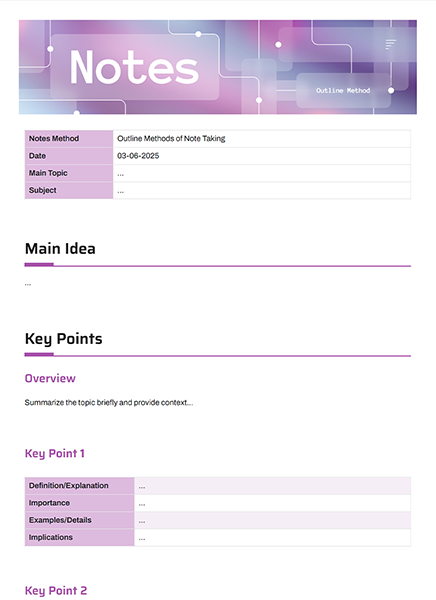
Key Elements of the Outline Note-Taking Method
- Date & Topic: So you always know when and why the notes were taken.
- Main ideas: The key points or themes under discussion.
- Subpoints: Details that elaborate or explain the main idea.
- Supporting details: Facts, examples, or explanations associated with the subpoints.
- Indentation levels: A formatting tool that clearly displays relationships between ideas.
How to use this Outline Note-Taking Method
This approach is most effective when you capture information while it is happening, as it allows you to bundle related items into larger ideas. To use it correctly, try using a step-by-step approach to enable your notes to be organized and functional later.
Steps to Use the Outline Note-Taking Method
Step 1: Begin by writing the date and subject/topic at the top of the template.
Step 2: When you listen or read, distinguish main ideas and note them as main bullet points.
Step 3: Under each main idea, indent and add relevant details that explain or elaborate on the main idea.
Step 4: Add supporting details, examples, or references, even more indented, under those subpoints.
Step 5: Go through the outline after the experience to revise your structure and add missing ideas or details.
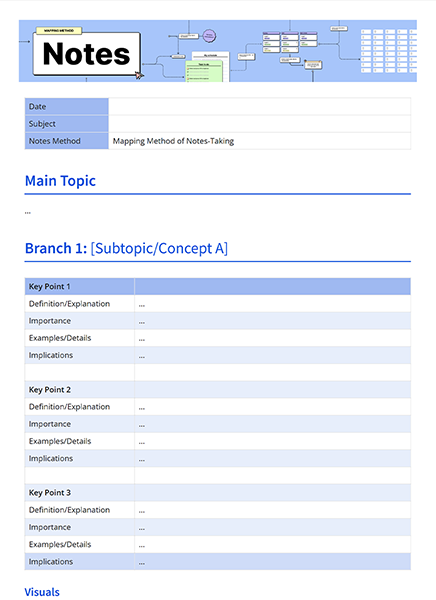
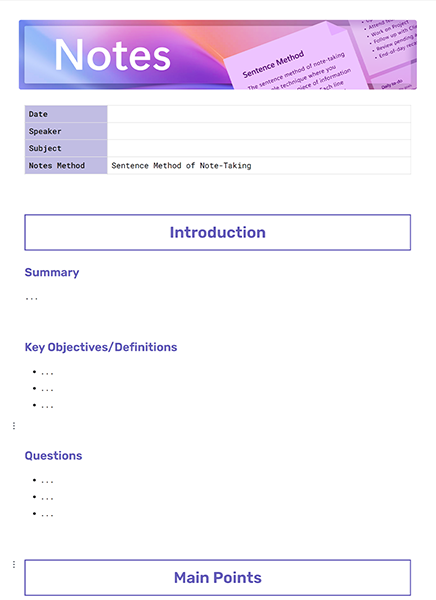
What’s Inside This Outline Note-Taking Method
This template is designed with simplicity and usability in mind. By using it, you can keep your notes neat and properly layered, no matter the subject or situation.
This Customizable Outline Note-Taking Method Layout Includes
- Date/Topic Header for quick reference.
- Main Ideas Section for capturing big-picture points.
- Indented Subpoints that keep ideas connected and logical.
- Supporting Details Lines for examples, facts, and explanations.
- Tips Section for reminders on how to apply the method effectively.
Why You Need an Outline Note-Taking Method
The outline method is more than just a format—it’s a thinking tool. Breaking information down into main topics and subpoints helps prevent your notes from becoming overwhelming or scattered. This makes it easier to absorb complex material, spot relationships between ideas, and create a reliable study or reference guide for later use.
How to Fill Out an Outline Note-Taking Method
To begin completing this template, take the major topics discussed from your lecture, meeting, or reading material. Next, build the ideas downwards by providing details and supporting facts in the correct order. The indentation scheme allows you to separate concepts and the overall design visually makes for an appealing, neat, and more precise reading.
Who can use this Outline Note-Taking Method
This template is ideal for:
- Individual learners seeking an efficient way to take lecture or study notes.
- Professional practitioners who require organized documentation from meetings or presentations.
- Researchers who need to document hierarchical relationships between ideas.
- Project teams which require organized documentation to support collaboration.
FAQs
Q1. Is the outline method suitable for fast-paced lectures?
Yes, it works well as long as you capture the main ideas first and fill in the details later.
Q2. Can I use this method for visual learners?
While it is primarily text-based, you can complement outlines with diagrams or charts.
Q3. Does this method work for project planning?
Absolutely—it’s excellent for breaking down large projects into smaller tasks.
Q4. How is this better than freehand note-taking?
Unlike freehand notes, outlines follow a logical structure, making review and recall much easier.