FREE TEMPLATES
Best Cost-Benefit Analysis Template
Use this free, customizable Cost-Benefit Analysis Template to evaluate projects, weigh options, and make smarter financial decisions—all in one place. If you're planning a new initiative, evaluating investments or reporting results to stakeholders, this template can help you organize the data systematically, compare costs and benefits, and give clear recommendations.


What is a Cost-Benefit Analysis Template?
A Cost-Benefit Analysis Template is a structured tool used to compare the costs and benefits of a project or decision. It is helpful for teams to identify direct and indirect costs, assess tangible and intangible benefits, and provide financial metrics e.g., ROI., NPV, and payback period. This approach helps leaders and teams have an accurate and unambiguous understanding of whether the benefits exceed the cost and make a more comprehensive decision.
Benefits of Using a Cost-Benefit Analysis Template
- Ensures clarity by listing both direct and indirect costs.
- Improves financial accuracy with ROI, NPV, and payback calculations.
- Supports better decisions by comparing costs and benefits side by side.
- Simplifies communication with stakeholders through structured summaries.
- Identifies risks by analyzing best case, worst case, and most likely scenarios.
What should be included in the Cost-Benefit Analysis Template?
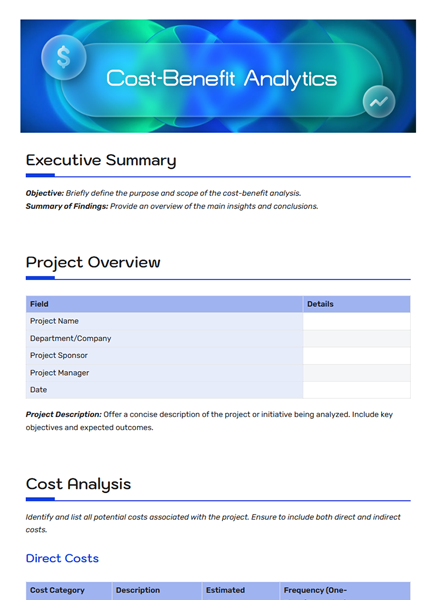
A strong Cost-Benefit Analysis template should capture project objectives, detailed costs and benefits, financial metrics, and recommendations for next steps.
Key Elements of the Cost-Benefit Analysis Template
- Executive Summary – Purpose, scope, and findings at a glance.
- Project Overview – Information such as the project name, sponsor, department, and project description.
- Cost Analysis – Breakdown of costs, both direct and indirect, recurring, and one-time.
- Benefit Analysis – A breakdown of both tangible and intangible benefits; values, and impact.
- Cost-Benefit Comparison – Key metrics; NPV, ROI, and payback period.
- Sensitivity & Scenario Analysis – Impact of different assumptions on results.
- Conclusion & Recommendations – Summary of insights with actionable next steps.
How to use this Cost-Benefit Analysis Template
This template is designed to streamline the process of evaluating investments or projects. By walking through costs, benefits, and financial metrics in one place, you can make balanced and evidence-based decisions.
Steps to Use the Cost-Benefit Analysis Template
Step 1. Start with the Executive Summary – define the project purpose and outline findings.
Step 2. Fill out the Project Overview – capture project name, sponsor, department, and description.
Step 3. Conduct the Cost Analysis – list direct and indirect costs with estimated amounts and frequency.
Step 4. Complete the Benefit Analysis – detail tangible and intangible benefits, with values or qualitative impacts.
Step 5. Compare results in the Cost-Benefit Comparison – calculate ROI, NPV, and payback period.
Step 6. Conduct a Sensitivity & Scenario Analysis - test a variety of assumptions to see how outcomes change.
Step 7. Conclude and Make Recommendations - summarize your findings and propose next steps.
What's Included in This Cost-Benefit Analysis Template
This template provides a structured way to evaluate if a project or investment makes financial sense. From executive summaries to scenario testing, it covers every detail needed for thorough analysis.
This Customizable Cost-Benefit Analysis Template Layout Includes
- Executive Summary – Purpose, scope, and summary of findings.
- Project Overview – Key project details including sponsor, manager, and description.
- Cost Analysis – Direct and indirect costs with categories, amounts, and frequency.
- Benefits Analysis - Tangible (e.g. revenue, savings) and intangible (e.g. reputation, satisfaction) benefits.
- Cost-benefit comparison - ROI, NPV, payback period, and summary table.
- Sensitivity analysis - Assessing how assumptions affect results.
- Scenario analysis - best case scenario, worst case scenario and most likely scenario.
- Conclusion & Recommendations - Conclusions, recommendations, and next steps.
Why You Need a Cost-Benefit Analysis Template
A cost-benefit analysis is not just about crunching numbers—it’s about ensuring decisions are backed by evidence, not guesswork. This Template will enable you to include both costs and benefits in one consolidated place, appraise financial performance, and check for risks before deploying resources. By creating clear comparisons and practical recommendations you identify the projects which will create actual value and avoid diminishing returns.
How to Fill Out a Cost-Benefit Analysis Template
To get the template filled out, summarise the project purpose in the Executive Summary, fill in the Project Overview with the relevant information, then complete the Cost Analysis and Benefit Analysis. Use the Cost-Benefit Comparison to calculate ROI, NPV, and payback period. Include a Sensitivity and Scenario Analysis to examine key assumptions and variability. Finally, bring it all to a close with a Conclusion & Recommendations; this ensures decision-makers get clear and actionable steps.
Who can use this Cost-Benefit Analysis Template
This template is ideal for:
- Project managers evaluating the feasibility of new projects.
- Finance teams thinking about an investment or budgeting decision.
- Executives making strategic decisions at a high level.
- Consultants evaluating a client project or proposal.
- Startups and businesses evaluating options before making an investment of resources.
FAQs
Why is a Cost-Benefit Analysis important?
It provides a structured way to evaluate if the benefits of a project outweigh its costs, reducing financial risks.
What’s the difference between tangible and intangible benefits?
Tangible benefits can be measured in money (like revenue or cost savings), while intangible benefits include qualitative factors (like reputation or satisfaction).
How do ROI, NPV, and payback period help decision-making?
They give you measurable financial insights into profitability, long-term value, and recovery time for investments.
Can I use this template for both small and large projects?
Yes. This template adapts to projects of any size, from departmental initiatives to enterprise-level investments.